Wednesday, 27 April 2011

The Story so Far.


www.adventureflyfishinguk.co.uk

So the trout season is more than one month old here already. It has been a strange one so far. It hasn't felt like the start of the season it feels a bit like the high summer, dog days. Low river levels, flat calm lakes, suncream and seeking out the shade, this doesn't feel like April!

early April on the top of Bodmin Moor, more usually the scene for waterproofs and general grimness...

Nevertheless, unperturbed by the difficult fishing conditions we have been out and about on the hunt for the local trout and some early exploration on the coast for bass and mullet. 'It's a tough job, but...'! And we have had some success with nice wild brown trout from our reservoirs and plenty of hungry little fellas from what are left of our streams. These difficult conditions have meant that we have also had to be a little more imaginative in our pursuit of sport with some 'unconventional' fly fishing targets - more on that in a later blog.

In between fishing, sun bathing and ice creams we have been doing some fly casting tuition and some fly fishing guiding. The weather has been perfect for teaching with very little breeze to think about and warm water around the toes. When it has come to catching fish though a little perseverance has been required at times.

A nice fish, about to be returned to it's warm bath.

Any way that's it for now. Don't forget we have some courses coming up, a beginners day in June and a casting workshop in July, details on the courses page, if you want to know more just drop me a line.

Derrick


Thursday, 21 April 2011

WE'RE BACK!!!


www.adventureflyfishinguk.co.uk

Did you miss us???!

I know it has been a while since you heard from us but we haven't been idle at Adventure Fly Fishing UK. For a start we have a brand new website, please take a look and let us know what you think. We have some new fishing venues for this season including exclusive access for guiding and teaching on a beautiful private lake on the edge of Exmoor, stocked with hard fighting rainbows, it is perfect for casting instruction and introducing newcomers to stillwater flyfishing. There are a couple of other exciting new venues as well, I will be writing about them in the very near future.

We have just published dates for Adventure Fly Fishing UK courses that are coming very soon. We have a beginners course planned for the 5th June, these courses were popular last year and we are back at Wistlandpound this year. Also as a result of some feedback last year from more experienced anglers, looking for an opportunity to sharpen their skills or to learn some new casts, this year we are holding casting workshops with the first one planned for the 9th July. You will find more details on the Courses page, should you want to find out more just drop me a line. We will be publishing dates for our popular saltwater fly fishing courses soon.

So I finally think we are ready for a fantastic season, teaching, guiding and FISHING. Bring it on!

Sunday, 1 August 2010

Dunster Do, Bass & More!


www.adventureflyfishinguk.co.uk


Well, July soon passed us by. The weather was a bit more mixed than it has been of late, and it allowed us to try out a few new stretches of rivers and streams that had been too low to warrant the journey out. There hasn't really been enough water to do too much to the river here, but any fresh water was a bonus. A bit further down stream they have had quite a bit more and the rivers over at Tavistock have reported some good Salmon and sea trout been caught. Recently we have been finding that most of our fishing sessions were starting late on in the day and running into the early hours. Having spent a few late nights searching for the bigger browns that are resident in the rivers, we were blessed with some of the biggest wild trout I have seen down here. To catch a 10 inch fish is a decent fish, and a bonus. To catch three 2lb trout in three casts is unheard of! This was the luck that good mate 'Oddie' had during a late night session last week. It has been a case of trying a few different methods, tackling the deep gorges, use big flies and wade through the deeper faster runs that did the business. Having spent the early part of the season fishing the same pools in a more traditional approach, it was nothing compared to what was going on with the method change and when the sun goes down.


It soon gets you thinking. Do the big resident brown trout that live in these small streams really feed much on fly life? Do they bother to rise to a size 20 spent gnat, pick off small stoneflies or caddis as they grub around in the stones, or do they feed on something more substantial? A big fish in these small streams will need as much protein as possible to grow to the size that we have witnessed. A lot of anglers talk about these moorland streams been void of food. Personal experience has proven that there is quite an abundance of food at times, but what there is, is often on the small side. Unlike a lot of streams and rivers throughout the country we aren't blessed with the large up-winged flies or big stoneflies that lift off. We have our own variety of small flies such as midge, yellow sally, small-brown stoneflies and sedge. So have the trout turned their attention to small salmon and trout parr as their main food source? Have the upper reach trout turned ferox? The way that they took the flies, were certainly similar to how a pike hits a bait fish fly. It was pure aggression! The first time I hooked into ferox trout was on one of the big lochs in Scotland back in the eighties. Loch Awe is well know for it's ferox trout which can grow over 30lb in weight. Living at depths of up to 100ft plus, they often feed solely on other trout. And now again as a lucky pike angler you can sometimes latch onto one whilst fishing the deeper water using pike tactics. Unfortunately our moorland trout will never reach the huge sizes of other ferox trout. But what it does show is, that there are a few trout out there doing something different to most of the others!


Loch Awe at Killchurn Castle


A beaut of a ferox trout from Loch Lomond*


It was good to meet up with Derrick and Deb's to spend the day at the Dunster Country Fair in Somerset. We were kindly asked if we could do the fly casting demo's and be on hand to give tuition and advice. We arrived the evening before to set up the pitch and to check out the fly casting area. I arrived at Dek's house with few rods, reels, lines and my tent in-hand. I thought 'job done!' But Deb's had put the real work in for the show. For that I would like to say 'Thank you'. She had spent the previous weeks working on photo boards, posters, leaflets, banners, you name it, she did it! I felt guilty that I had only turned up to help with the casting demo's and tuition. But true to form, if I was given a task to do I tried my hardest to get out of it. But she soon had us knuckling down.


It was nice to be in Somerset again. Having lived and worked in the county for a year prior to the shift to Devon, it was good to be welcomed back for the day and nice to speak to some of the regular fly fishers that I knew during my time there. For those thinking about trying a bit fly fishing in Somerset there are some really nice water's worth a cast. For the stillwater angler there is the stunning 'Wimbleball Lake'. At 374 acres it's not a water to be sniffed at. Wimbleball is situated near to a little village called Dulverton and used to be renowned for it's trout fishing. Still a good water with a reasonable head of fish, but the stocking policy and numbers of fish stocked per season has dwindled over the years. Wimbleball lake is a good early season water, and has the option of both boat and bank fishing. Most stillwater patterns will catch, but the most productive flies tend to be Montana's, Buzzers, Damsels and Blobs. For more info, you can ring the guys at Wimbleball on 01398-371460 or email info@swlakestrust.org.uk


For the river angler, Somerset streams run through some of the nicest scenery anywhere in the country. Whether you are looking to catch Brown trout, Sea trout, Grayling or Salmon, one of the most famous rivers is the Exe. Starting it's life high up on Exmoor, it works it's way through Somerset and Devon before emptying into Babbacombe Bay near Exmouth. Along it's length there is some excellent river fishing to be had. Another little stream that is worth the effort is the River Barle. Again starting high up on Exmoor at Pinkworthy pond, it works it's way through Simonsbath to Dulverton where it feeds into the river Exe. Most of the stretches are private or club water, but membership for the fishing on some of the beats is a reasonable price of £25 per season! For more information you can get in touch with Pat or James at Lance Nicholson Tackle & Guns in Dulverton. Their phone number is 01398-323409 or drop Pat and email at lancenich@lancenich.f9.co.uk


Deb's taking it easy, whilst we do all the work!


aff-UK was back over at the coast over the weekend in search of a few Bass. The first day was a bit breezy to say the least but there were a few fish moving and searching out a meal. The fishing was a bit tough due to the conditions, and especially hard to spot fish. When bass and mullet are present it's always nice to be able to see them and make a cast to a particular fish instead of having to fish blind. But when your there, your there, so it was a case of making the most out of it. Sunday was different all together! Blue sky, blue water, black shapes and silver flashes. This was more like it! We had the company of a group fly fishing nuts who wanted to get their strings pulled by a few of these SW bass. We started off having a try for a few of the mullet that were holding in the estuary prior to the tide flooding. As per usual, they were finicky and hard to get hold of. But saying that they were taking the flies. Maybe a bit of angler error may have crept in somewhere. That seems to be mullet fishing all over. If it's not perfect, then they seem to know that something is amiss and swim on by.


The bass on the other hand came in like an invading army once the tide had turned. I would hate to be a meal when these things are on the feed. Looking across the estuary through the shallow water, you could easily see pods of up to 100 fish at a time swimming around. They were everywhere! A couple of the guys had never caught a bass before, so it looked like today was the day. It was a mixed group of guys consisting of fly fishers, course anglers and first timer's. So it was good to see everyone bent into fish. I'm not usually a numbers kind of angler, but between the five who were fishing they managed to catch an impressive 160 bass between them. The flies that were doing the business were thunder creeks, Clousers, flash minnows, and surface poppers. All the fish were returned which was good to see. Admittedly most were under limit, but the ones that could of made it into the pan, were still put back to continue to produce more fun for future seasons.


Kevin & Dek releasing the first bass


Paul with a nice 'Popper' caught Bass


Barry's first ever bass on the fly!


Quentin getting amongst the fish.

At the moment Derrick and myself are holding our breath that the weather starts to ease a bit over at the coast. Carl the Shark skipper had to cancel one of our trips due to Strong winds. So fingers crossed that we can get out on Monday to get into a few of the big 'Blues' that he was talking about. So we will keep you posted on how it goes. If anyone is interested in having a day tackling sharks on the fly, we are more than happy to help.
* Photo courtesy of Ferox Trout Forum.


Monday, 21 June 2010

'The Aquarium'


www.adventureflyfishinguk.co.uk


Looking across the rippling stream, I could see a beautiful rising trout gently sipping 'Procleon bifidum' in the distance. Careful, quiet walking like a deer in the forest, making less sound than a gliding otter was the approach needed for my success. I stopped and peered as a king fisher flew by, and then from nowhere felt the draft of breeze blow onto my face as a passing barn owl sawed passed me. I stopped, knelt down and evaluated my approach. As I knelt in the cooling evening sun, I saw another rise. Staring like a wiley fox, I knew this fish would be mine. Making my way, step by step, creeping and ducking under overhanging branches to subdue my silhouette I carried on watching, staring and learning the feeding habit of my chosen fish. It rose again and again. My heart started to beat a little faster. I was nearly in range and my prize was in the prime feeding flow. Should I cast or let her settle down for a while? Should I re-check the size and choice of fly again or have the confidence that my selected pattern would fool this beautiful elegant fish? Attached to the end of my tippet was a perfectly tied pale watery dun pattern. It had fooled many Salmo-Trutta in the past, but would it work this time? As I looked around to check for casting hang-ups, everything seemed clear to make a cast. Again I paused as my old friend the barn owl breezed back down stream in my direction. It hovered, as to tell me to "make the cast".

I decided to hold back a little longer to think my plan. Pulling my pipe from the upper pocket of my tweed fishing waistcoat, I turned my back to light and smoke my favoured tobacco. The scent and smoke began to drift downstream indicating to the me the wind direction and strength. Again as I looked, my fish began to feed. This time it looked to be taking an emerging 'Rhitrogena Semicolorata' or Olive Upright for the non-fly fisher. I quickly pulled my fly box from inside my fishing bag that was draped over my left shoulder and began to study the contents in it's entirety. Running my finger along each row, I was looking for the perfect fly for the perfect cast, for the perfect fish. Most were the wrong shade of olive. Some were too dark, some were too light. Some were too big and some too small. I was looking for one with the correct mix of grey/olive with a hint of brown dubbing running through the abdomen. Hook size and overall fly size meant everything. I had a lovely looking Kite's Imperial tied on a splendid size 16 up-eye hook which seemed perfect for the quest ahead.


Snipping off my original choice pattern, I attached the kite's Imperial dry fly and prayed it would rise my butter coloured beauty once again. Taking my time to make sure everything was correct, I used my favored half blood knot and degreased the tip of the cast and applied a drop of quality floatant to the fly. I once again crept into position, this time to witness a family of otters making their way down stream of me. I held my breath, hoping that they would keep moving and not change their direction and head towards my feeding prize. Surely they must of picked up my scent and had opted to keep a wary distance. I just hope the trout wasn't as wise to my presence. It was now or never! Taking to one knee, I pulled five foot of floating fly line from my loaded fly reel and placed the fly perfectly upstream of the last rise. I looked on as it drifted into the feeding zone, and without warning my old split can rod buckled over. She had taken! Now it was down to me to make sure she was played in a manner that Mr Frank Sawyer would of been proud to have witnessed. She knew her lair well. Spending years cruising, swimming, living and feeding in that area, she was wise old creature.


Sounds pretty good. I wish my day's fishing was as thought provoking as that! In fact it was written by a non-fisher who had a browse through a fly fishing book and had a good thought of how fly fishing usually is. In reality, or in my case anyway the only reality to the J.R. Hartley style writing is that I will be in a stream somewhere trying to catch trout. It's a good point to prove that it can be easy to try and pull the wool over peoples eyes. I have read countless articles that reveal themselves more when you read between the lines. On of the last articles that I read was about fly fishing for pike. Having spent the last twenty five years searching for, fishing and understanding the species, I'm as keen as the next guy to learn more. But when reading it, you could see, or rather read that the author had only recently started fly fishing for them. Giving people advice on how to do things should be right if you are going to write about about it. Maybe it wasn't the authors fault that there were quite a few points that weren't right. It perhaps should of been down to the editor of the magazine to make sure that the facts were correct before printing.

So how have things been down here in sunny Devon. Hot and sunny! The rivers and streams are still as low as I have seen them. The fishing has been good since writing the last blog. I was pleased to catch up with Ollie again the other day for a look in the river Okement. Not the best of fishing weather, but like most I'm sure the trout are getting used to it by now. I had spent the morning fly fishing on the East Okement struggling to find too many willing fish. It is surprising that two similar streams the are only half a mile apart can fish so differently. They both start near and run through Okehampton Artillery Range, passing either side of Yes Tor and High Willhays, before the West Okement is dammed at Meldon reservoir. Meeting up with Ollie, we set up a couple of light weight fly rods and headed off from the old park and headed towards one of the deeper pools on that stretch. I had been down there a few nights previous and had seen a good number of decent fish in there. There was plenty of food around and the trout were busy feeding on sorts sort of fly life including midge, yellow sally and olives. It was good to sit in the sun and watch what was going on. I'm no Bill Oddie, but watching a couple of Damselflies going through their mating ritual took up a few minuets whilst Ollie got into fishing position. It was a shame that a trout grabbed the female Damsel fly from the leaf just after taking the photo. At least it's main aim in life had been carried out. Leaving a nice conveyor belt of food for the following season or two.


Even Damselflies need a bit of privacy during the moment!


The pool that we chose is often affectionately referred to as 'The aquarium'. If Ollie could manage a few fish out of it, then the name would probably stick.


The 'Aquarium'.

It is a weird pool to fish due to the nature of the flow. Basically it is one big back-eddie, so the usual rules of fishing don't really apply. The first thing that you notice is the way in which the fish are holding and searching for their food. Unlike the usual downstream flow where the fish tend to look upstream and swing around a cruise around the pool feeding. Probably 80% of the fish are facing downstream or across, looking to feed as the food passes them by in an upstream direction. When fishing these types of pools, I find it best to keep the casts short and pick off the front fish first and then extend the length of line and fish for the further fish afterwards. Otherwise you end up pulling fish through the rest of the shoal, spooking most of them in the process. Typically on this pool, the better fish were the furthest away tucked in under the bushes and hanging off the main flow that pushes through the edge of the pool. Just like most types of fly fishing, it comes down to catching a few and loosing a few before you get your head around the way that is the most productive.

Ollie decided on the fly choice and spotted a fish that he wanted to pick off. I just gave him a couple of pointers on the type of cast he should use, as there were plenty of overhanging tress willing to catch the fly. First cast and a fish took straight away. It's nice when that happens. His fly choice was a duo set-up with a small olive klink and a small Pheasant tail hanging underneath. For some reason there was a bit of colour in the river, but you could still see as at least half a dozen fish shoot over to the fly as it hit the water. Unfortunately for him, it was one of the smaller fish out the shoal that was the quickest (or daftest), to grab the fly first. But that's fishing. It sometimes takes a bit of luck to home in on the bigger fish. I have seen it countess times especially when pike fishing, watching a large fish follow the fly in, only to have it taken by a smaller fish that rockets in from nowhere.


First cast, first fish of the day!

It was a lazy day of chilling and fishing the pool and joining runs. I know I have been going on about how low the waters are at the moment, but there are now trees starting to sprout where the water usually runs. This is where all of the fly casting practice pays off. With all the bank side vegetation, plants growing in the middle of the river, exposed stones and rocks, twigs and logs poking out of the water, it doesn't take much for a stray cast to get snagged. It was good to watch Ollie figure out the flow and the cast, that would cover the fish. We fished until dark, with Ollie catching a good number of fish with a couple of better trout grabbing the dry fly as it drifted back up-stream.


Going back to the beginning of the blog. The person who wrote it mentioned all the types of wildlife that they thought was the norm. In fact I don't rally see that much during a trip out. I manage to see the odd crow or seagull if I take my eyes off the water. But what was nice was to catch a glimpse of some feeding deer in the old castle meadow as we were walking back down stream towards home.


Catching up with Derrick the other day, it was good to hear about his recent sea trout expeditions. Things have been tough and I give him credit for the effort he has put in. He has driven hundreds of miles, coming down this end of Devon to have a crack at the Lyd sewin. There are some good fish in there and good fish come out every season. But due to the conditions it has been a little bit hit or miss of late. But sticking it out with Tim Smith from the Arundell Arms they have managed a few fish. Next week Derrick is back off home to Wales for a few days sewin fishing on the river Towy. Fingers crossed for him that the conditions are good and he catches a few good fish.


A nice Lyd Sea-Trout for Dek.

Along with the river fly fishing that has been going on, we have been over to the coast again for look at the bass and mullet fishing. The mullet numbers seemed to have shrunk though since our last visit, but according to Derrick he knows where they are and we will be out for them specifically next week. The bass on the other hand are around in good numbers. They were happy chasing clousers and thunder-creeks around. Nothing big came out, but there were a few nice fish spotted amongst all the basslets. I decided on a 4 weight out fit, so most things still pulled back a bit.


Not many chips needed with these.


Friday, 4 June 2010

News Flash!


www.adventureflyfishinguk.co.uk


News flash! The weather has briefly broke and we were treated to a bit of long overdue rain. Well it rained for the day and the rivers rose and inch or two before falling for tea-time. Even that small amount of fresh water had the fish coming alive. Looking up stream as I passed over through the park, the pools were alive with rising fish. It has been a busy week. Fishing has taken main priority again (as it always should do), and with trips to the coast, moorland fishing and a visit from my brother and good mate roz, meant it has been a hectic week.


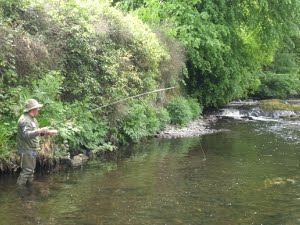
It was good to meet up for a morning session with local fly-fisher David Wright who was looking to get into a few Okement trout. He is a lifelong fly-fisher and also a magician. So I was hoping he would teach me a few tricks and pull a few fish out of his hat. The weather was another bright, sunny and warm morning. The afternoon was going to be a lazy day at the coast chasing mullet, and it looked like it was going to be another hot un. I met up with David by the castle and we decided to head up-stream and look in a few of the pools that we haven't had chance to fish since last season. There were plenty of midge and stonefly milling around and it didn't take David long to get the fish going. Fly choice was a simple 'F' fly. Simple to tie and a pattern that is always worth keeping in your box. He was catching fish from upstream, across, down and from all sorts of weird angles and drifts. The fish didn't seem bothered what the fly was doing. I think he had four or five fish in as many casts.


Mr Magic lifting off for another cast!


I had to leave David causing trouble amongst the trout, and as he headed further upstream I climbed out of the river and drove over to the North coast to meet up with Derrick for a crack at the mullet. He had done well at the same mark a few days prior, so I was looking forward to seeing if they were still around and getting into a few of them. Low tide was at 1:30pm and it was a bit of a rush to get over there in time, but taking a few shortcuts off from the main roads it wasn't too long before we were making our way down to the estuary. As we walked over the rocks and kelp to the edge of the water you could clearly see the tell take shapes of some big mullet cruising and rolling in the weed. With big silver flashes in front of us it was time to get a fly wet and see what was going on. Water depth at the time was about two to three feet and the fish were still spooky. It didn't take Dek long to have a couple of quick takes though, but true to form they didn't stick. I worked an area that seemed to be stuffed with fish. Again, quick takes and they were off in the opposite direction. Eventually as the tide turned, the fish switched on and they were all over the flies. We tried a variety of patterns including small clousers, nymphs and shrimps. It was interesting watching how they reacted to each type of fly that cast towards them. Some were hit straight off, some they wanted to inspect first. But as long as they were taking we were happy.


A bit of afternoon mullet action!

The session was another good one with us both managing a few fish between us. Once the tide flooded in the sport became harder as the fish pushed out of casting range and our cut off point was starting to fill behind us. I knew I had to rush back to meet my brother back in town, so I made my way over the dunes, said my goodbyes to Dek and started the drive back. So far that day, I had managed to fish from the source to the sea. Not bad for a day's work, and with my brother and friend down there was a bit more on the cards. For anyone fly fishing for bass and mullet, one fly line that is brilliant for the job is Rio's Clouser line. Designed with a similar profile to the stripper bass and pike lines, it is designed for casting flies into a wind and will defiantly help in tough blowy conditions.


The following morning we had planned on having bit of a leisurely stroll along one of the coastal paths that runs from Looe to Polperro over in Cornwall. I don't know what it is about going to Looe, but I love it. We have been going there for the past twenty years and I never tire of the place and there is some excellent fishing to be had there. Whether you want to hire a charter and go out for the sharks or congers, go on a little 2 hr mackerel trip or take to the rocks and fly fish for a variety of species! It has it all. Apart from reminding you of the old Jaws movies it also has some of the best scenery anywhere in the world. After the short drive, the first stop was to grab a brew and a cream-tea before setting off down the path. Or should I say up the path! The idea was to walk along the coastal path, and where possible clamber down to the sea and try fishing the bays and inlets to see what was around. Basically it was bit of a recce for my own fly fishing and doubled up the day with a bit of sight seeing for my brother and Roz.


The start of it all, looking down the river Looe.


The start of the walk is a nice easy wander through the old town of Looe and after a steep walk up to top of the hill, you begining to see the coastal path in the distance as it climbs and twists around the headland.


Looe Island, one of the famous landmarks.

In general, the route is easy. Overall distance is about five miles of up and down walking, but nothing too much. The beauty of it is, once the walk to the other end is reached you have various ways of getting back. You can either walk, catch a bus, taxi or boat. We weren't sure which we were going to do until getting there. If we got there too late, then we could be walking back! It didn't take long to find likely looking fishing areas. During most of the walk, the tide was still out so this gave us the perfect opportunity to get down and have a good look around.


The kind of places we were looking for! When full, these areas would hopefully be stuffed with fish.


Once you were down in the bays and coves, you could of been anywhere in the world. Well, anywhere that was stunning, hot and near to the sea. It became apparent that there would be some good cove and rock fishing to be had. There were plenty of routes down to the shore, either by path, scramble or climb. Better still would be to come in by kayak, which would give you access to all of the area. A nice gentle paddle along the shoreline and hop in for a fish and a BBQ, what more do you need!


Paddling in by kayak would be the easiest way to reach all the areas.


The further we walked, the more rock fishing we spotted!


By mid afternoon the temperature was in the mid eighties and we were sweating like pigs! So taking a break we had some lunch and I went to investigate if there was anything willing to grab hold of a fly. After bit of a scramble down a small cliff, we reached a breathtaking bay. Again the tide was still out a bit further than we wanted, but there wasn't any complaining. We chilled in the sun, grabbed a bite and had a fish.


As tempting as it was, we didn't have a dip- (Apart from some Dorito's and a chili dip).


Trying not to loose my balance on the knife edge rocks.


After a full day of hiking, scrambling, casting, fishing and eating we finally reached our destination in one piece. Again, Polperro is a stunning traditional Cornish fishing village. Most famous for it's smuggling history, you can see why it was a good drop off point for the rum and tobacco runners of old.


Nearly there! Looking down into Polperro harbour.


Once in Polperro we thought it would be best to check what time we would have to leave, otherwise it meant we could have to make the same route back on foot! It wouldn't of been a problem, but Baz and Roz fancied a BBQ sometime that day, so we had to get that sorted. We had a couple of hours to kill, so we fished and chilled for the remainder of the time before setting back. The preferred choice of travel was by boat. Within five minuets of getting into the boat back to Looe, the weather changed and a sea mist began to cover everything around us! So much for the nice day!


Leaving Polperro in a cloud of crappy weather!


After the rocky boat trip back into Looe harbour we walked down to see if there were any fish moving with the turning tide. Were there any fish? The answer was yes! One of the biggest mullet shoals that I have ever seen there were crashing all over the place. Judging fish size from afar can be a guessing game, but I'm certain there were some fish over 8lb cruising around. If only I could of gotten down to them!!! True to form when we got back into Okehampton, Baz and Roz went off to fetch the BBQ supplies and we headed off in search of a midge free area. We chose a little spot next to the river where we had a quick flick and pulled out a few small browns whilst the pig bits on sticks were burning away!


Not a bad end to a perfect day! Baz on the BBQ.


www.adventureflyfishinguk.co.uk

Saturday, 8 May 2010

Out and About- Wild Style.


www.adventureflyfishinguk.co.uk


It seems like ages since I last sat down and wrote a blog! So much so, that I forgot how to log-in and spent twenty minuets pressing buttons and trying to remember pass words. Whey-hey, but at last I managed it! I'm not really a computer kind of person. I am much more hands on. Give me an old stick and a knife and there is more chance of me whittling a clothes peg than there is of spending hours tapping a key pad. But never the less, I managed to get into the system and I'm away.


I woke up this morning to find my home town of Okehampton busier than usual. Originally coming from a large city, you soon get used to the quiet life of living in a small town after a while. So when it is full of people milling around and cars queuing all over the place, you know that something special is going on, or everyone was vacating town! This weekend is the 50th Anniversary of the 'Ten Tors Challenge'.


For those who have never heard of the 'Ten Tors' before, it is basically bit of a ramble up on the moors. A quick walk to the top of a rocky outcrop (tor) in the middle of no where, probably in the rain and then back down for tea and biscuits. If any pubs are en route, then perhaps a swift half and a bowl of water for the dog. Well, that would be my ten tors challenge anyway! Unfortunately, in reality it is nothing like this. Regularly guiding and fishing on the moorland streams, I know the terrain and area well, and the kind of hard work that people have to put in to complete such a task. Each May, hundreds try to complete the Dartmoor tradition of covering set routes of either 35, 45, or 55 miles, hiking over ten listed tors over a two day period. Overseen and manned by the armed forces this is a test of endurance and pride. And like usual, it started early in the morning and will finish back in Okehampton the following night. Hence the reason for all the back-packs and walking boots on show in the middle of town. At least for once I didn't look like the odd one out!


The first tor that is usually tackled on the challenge is Oke tor, which is our local tor and an area that I know well. On one side of it runs the East Okement and on the other is the upper Taw that runs through to Belstone village. I have spent countless hours fishing, hiking, scrambling and camping around this area, and have enjoying every minute of it. I doubt the competitor's of the ten tors challenge will have the added luxury of a bit of fly fishing during their time up there, but I'm sure they will enjoy the soak in the bath on the Sunday night. Who knows it might even be worth while setting up a stall at the bottom of the road selling bath salts and blister cream. I would like to wish them all good luck with the challenge and hope that the weather doesn't deteriorate too much more for them, than it has already started to do.


Personally I'm glad of this bit of rain and cloud we are having at the moment. It hasn't rained properly here in Devon for weeks and the rivers are still on their bones. We have still been catching plenty of wild browns, but it is about time that the system had a flush through with some fresh water and start to fill it a bit more. Even in some of the usual faster flowing water, it is having a job of drifting a fly downstream. I have just returned from a few days fishing on the moorland streams. The fishing was good, but selecting the best areas for the decent fishing meant bit of a walk. Most of the level is down by about two thirds, so a lot of the usual good runs and pools were nearly dry.


Instead of making the journey back and forth to the hot areas, I opted to camp out for a couple of days and soak up the rays. Even if the lack of water was affecting the river levels and fishing, I thought I would make the most of the nice sunny weather. No doubt it won't last for much longer and the rest of the season will be fished from looking under a hood. So throwing a few items into a ruck-sac I started the walk along the lower level path from town and began to fish along the length of the Okement as it wound it's way through the woodlands.


I tried to keep the kit as light as possible taking some of the strain out of the walking. If there is a couple of you taking on the trip then it easy to off load some of the weight between you. So it was a case of a small tent, light weight summer bag, therm-a-rest, dried food, a few spare dry clothes, stove, head torch and my fishing gear. If you are new to the area, or unfamiliar with the terrain and route then a map and compass would usually come. But this is a fly fishing route that I have taken many times before, so I left the extra weight at home and typically made it back up again with more flies.


Fishing in nearly a 'dry' pool, but plenty of fish were still in there.


Due to the level of the water and slowness of it's pace, presentation was critical. Sometimes when the river is in full flight and moving at a good pace then fly choice can be anything that is a slight resemblance of the food source. But when the fish have more time to inspect a passing meal, then tippets are as light as possible, fly size is reduced to miniature and looking through the fly box, the better of the imitation patterns were tied on. The day was spent fishing, casting, searching and walking. In the end I chose to fish a team of tungsten Stone fly nymphs and searched out the deeper pockets and pools. The fish came steady throughout the day as I made my way up stream and continued out of the woodlands and onto the bottom of the moors.


By the time I found a suitable camping area for the night, I set up the tent before it went dark, and carried on fishing to the bottom of the tors for a few hours before making my way back down for a cuppa and to get some food on the go. The menu was fairly basic. A few dried noodles and a cuppa soup. The desert made it complete though. A bag of m&m's! It felt a bit like being at home!


When it comes to wild camping on the moors, there are a few things to take into consideration. The first is to make sure your camp is in a suitable area. The Dartmoor National Park Authority
have guidelines that should be stuck to. With over 130 square miles of park, common land and wilderness to choose from, there is a list of things to do and not to do.


They advise that you:


  • Don't camp in an area that will affect nesting birds or lambing


  • Don't light camp fires


  • Don't over use a site, and only stay in small parties


  • Don't have a tent pitched in an area for more than two nights


  • Avoid pitching a tent on the mark left behind by another tent


  • Leave the area as you would wish to find it


  • Don't camp on archaeological sites


  • Don't camp within 100 meters of the road, or anywhere in site of farms or houses


  • Deal with all human waste responsibly


  • Be aware of military 'Live Firing' times and dates!!!!!!

All are good tips and pieces of advice, but perhaps the most important is the latter. Check when the MOD are using the moorland ranges for live firing. It is quite common for us to bump into troops as they are training. Most times you can go ahead and do your own thing. A commanding officer or look-out will inform you and ask you to keep to a certain path or route if you are going to interrupt a training exercise. It is a two way thing. As much as the forces need to train, they will also try and accommodate you using the same area. Only last week we held up 20 Royal Marines as they waited for us to fish a stretch of river that they wanted to 'dunk' their guys into. No doubt they were glad of the break, and actually seemed interested in the fishing that was going on. But when they are using an area for 'live firing' then this is a different matter. They do have flags and markers pitched when they are out on exercise to warn people about the dangers, and you will be told to move on if you get too close. After all, you don't really want to be woken up by a mortar round going off in your campsite!


I tend to carry drinking water with me when I'm going out for the day, but when an overnight stay is on the cards then I prefer to source water out of the streams. Water weighs about 1kg per litre. So on a hot day when you could be drinking up to a litre every couple of hours, then it is a lot of extra weight to carry. All water should be treated prior to use. Even though the running streams can look clear and clean, there could be a very good chance that there is a dead sheep or something rotting away in it somewhere further upstream. Drinking water can be treated in various ways from boiling, chemicals or filters. The cheapest and easiest way is to simply boil the water before it is used. If the water looks dirty and has bits in it, it is worth filtering the bits out before boiling it up. When using stoves whilst wild camping, always make sure it is placed on a flat stable platform like a stone. This will stop it from blowing or falling over, burning the grass or burning your campsite down. Another way to treat water is to use chemicals to purify it. Most common are chlorine tablets. They certainly do the job, but taste like your drinking swimming pool water. Nowadays there are some brilliant water pumps and purifying water bottles on the market. These aren't cheap, as much as £145, but if you into this kind of thing in a big way or you need to use a lot of water at the camp then they are certainly worth looking into.

Water purification is important, take precautions before drinking stream water.


Even during this dry spell we have been having, I have still opted to wear waders. In reality you could easily stick to the banks and fish from the waters edge without having to get in and get wet. There are a few reasons why I always wear waders on these trips. The first is to make traversing the moors a lot simpler. It means that if I did have to cross over the stream to reach another part, I could simply wade across instead of having to find a suitable crossing area or hopping across slippy stones. My luck would have me going for a dip and having to spend the rest of the day wet and cold. It doesn't take a lot to start to get cold up on the moors. Especially when the sun starts to drop or when a cold breeze blows across. Staying dry is a bonus, and when you are a few miles from home and having to sleep out, comfort is still the key. Another advantage of wearing waders is protection form all the gorse bushes that are dotted all over the place. You soon realise how sharp the thorns can be when you accidentally sit on one! As much as your waders protect you from getting thorned to death, they can soon puncture so it pays to watch out where your walking and pushing through to get to the streams. The last thing you need is a leaking pair of waders. They ain't cheap! Perhaps more important is to keep covered to stop an any sheep ticks latching onto you as you kick through the grass and bracken.


Sheep ticks or Ixodes Ricinus, are ugly little creatures. They are at their most active and prolific during April to October, feeding on sheep, dog, mouse, and human blood. They look like little grass crabs and will take advantage of any passing angler. You often see day walkers wearing short and t-shirts in the summer months as they make their way through the long grass. I know from personal experience about tick bites and the problems that they can cause. One problem with them is Lyme Disease is it's flu like symptoms that can spoil a good fishing trip. Left untreated it can start to effect joints, the nervous system and in rare cases people have died. So if you are spending time in 'tick country' your always best to keep your bare skin covered. It's also worth having a check over your body before getting into your sleeping bag to check that one isn't going to have a good feed whilst you are asleep. For more information on ticks and Lyme disease check out www.lymediseaseaction.org.uk


'Happy Scratching'.


It has been nice to spend a bit of time down at the coast and get into a bit of saltwater action. Since the beginning of April, Derrick and myself have been keeping a good eye on the Bass fishing along the North Devon coast. As early as it was, there have been some good numbers of fish moving over the marks and I'm certain the sport will be hot throughout the summer. We have had some good times over there already. One fly that has still being doing the business for us is the old Thunder Creek style fly. It's easy to tie, easy to cast, easy to fish! It's still an all round winner. And I'm certain it will still be getting bends in rods for seasons to come!


Derrick setting off in search of Bass action!


Saturday, 20 March 2010

The good, the bad and the ugly!


It was nice of the weather to hold for the 'open day' of the brown trout season down here in Devon. I say Devon, but as Derrick and myself had some other fly fishing business in Somerset we opted to fish the river Exe near to Dulverton. It is a stunning part of the world, and during my time here in the South West, I was lucky to live and work here for a season. So it is always nice to get back and meet up with a few old faces and run a few flies through some familiar runs and pools. Unfortunatly we didn't have too much time to fish, so after a quick pastie and a brew we popped in to see Pat at Lance Nicholson and then drove down to the river to make a start.

Surprisingly we had most of river to ourselves which was nice. But due to the lack of water we have had of late, the river was on its bones and crystal clear. Combine this with bright sunlight we knew it would be tough, but nevertheless we were ready for it. Like a gent, I let Dek have the first cast of the season, (well he is bigger than me)! There wasn't much sign of fish activity on the surface. There was a good hatch of midge and LDO coming off, but they got away un-attacked. So to make sure we had a double chance of connecting with something 'the duo' was the set up that we first tried.


Big Dek setting up, before making the first cast...


....then like a slow whippet making his way upstream.

Apart from the elements being against us a bit, things looked good. The flies were been fished well, the correct part of the river was been fished, the only thing that slowed down the action was the lack of fish! Looking into the river we didn't manage to spot any fish, but that didn't mean that they weren't there. Adapt at living in between the stones, weed and shadows of the stream bed, you will often be surprised by the size of fish that could be hiding just under your feet. Then with one wrong step you witness a large shape dart off in the opposite direction. So with this in mind we covered all the likely looking spots and the not so likely looking spots, just to please our own mind that we covered the water and any fish. We managed a quick flurry of action prior to the sun dropping, with Derrick pulling out of a nymph caught trout and I missed a quick snatch at a dry fly as it passed overhead a small brown. We fished hard, but the fish were even harder. It won't take long for things to really get going. A bit of water in the rivers, a bit of warmer weather to get some larger hatches going, and we will be back!!


The following day, it was good to meet up and take out up and coming local chef Ollie Stevens for a few hours on his local river Okment. He is a keen still water trout angler, but wanted to learn a bit about the wild trout and wild trout fly fishing. Living next to the river for most of his life, it was a surprise that he had never really fished it before with a fly. So he was looking forward to seeing what swam in it, and more so wanted to feel the pull of a fish on a fly rod. We started off on an easier stretch of the river. This was to help get Ollie confident in wading and practising a few of the various casts and mends that he would be using throughout the session. He was pretty good from the start. A few tweaks here and there and the odd reminder to keep him on track and he was away. Learning the difference of how a line works on moving water, and how everything effects the drift of the fly was the main point to get across. Unlike the still water trout fishing that he had done in the past, it was down to him to keep the fly moving as natural as possible by manipulating the rod leg of the fly line in conjunction to what the water was doing.


Ollie taking his first steps into running water.


Before long we came out of the flat stretch and made our way from town to the bottom of the moors, searching and fishing along the way. It was good to take Ollie out due to his enthusiasm for the sport. He was always asking questions, wanting to learn about the aspects of the set-up, fly life, fish behaviour and the art of fly casting. It is good as a guide to work and teach someone with enthuisiam and someone keen to learn and it wasn't too long before he was watching trout chasing after his small nymph and slashing at the dry fly. Hooking into the fish was another matter. But like I mentioned to Ollie at the time, a lot of this comes down to experience of hooking and loosing fish, knowing when to strike or when to let the fly to continue down stream.
The closer to the moors we got, the more the weather started to deteriorate. No surprise here, but Ollie didn't mind so we continued our way upstream. As the rain fell harder, we crossed the river and ducked into an old mining cave where we fired up a brew. There are quite a few of these ancient caves dotted around the moors and next to the rivers, and can be a welcome shelter when the weather turns. It was good to sit in the door way watching the rain hit the river and chewing the fat. But we decided to yomp up river to one of the high pools before the river started to rise. Within a couple of hours these small streams can soon colour up and become unfishable, so it was a race against time. Within half an hour we were standing at the base of the tors where the river was still running steady but started to stain, and Ollie began to fish eagerly to hook into a fish.


Ollie putting the lesson into practice.

With plenty of rises, quick snatches and missed takes it was good to watch Ollie connect with a nice fish. He had worked hard to land it and the smile on his face said it all. I just want to wish Ollie luck with his new found skills and hope to catch up with him again soon for another day. Who knows, he might return the favor and teach me how to cook!

This is what it is about. A stunning wild brown trout.

Just before I finish off this blog, I just want to say 'Thanks' for a few of the kind phone calls that I have received. For those who know us at 'Adventure fly fishing UK' will know of our little team mascot and buddy, 'Ratz'. Unfortunately she passed away yesterday after years of nibbling, stealing and playing with our kit and tackle! Born into a life of fly fishing she perhaps knew more about the textures and tastes of fly fishing gear than any fly fisher alive today. It is a sad time for us here, but true to form she had a little ratty funeral and was buried next to the river where I often cast and fish during my free time. On a posative note, at least I should get a bit more time from a fly line now! But she will still be missed.


R.I.P 'Ratz'- 2006-2010.